
Parasomnia Disorder: When Sleep and Wakefulness Overlap
Sleepwalking, screaming during sleep, acting out dreams, or waking up confused, disoriented, and slow to respond aren't just 'quirky' sleep habits — they can be symptoms of parasomnia, a group of sleep disorders where the brain doesn't fully separate sleep from wakefulness. Left unaddressed, parasomnia can affect sleep quality and disturb family members too. Dr. Manish Aggarwal, a Pulmonologist and Sleep Specialist, helps patients and families understand what's happening during sleep and provides an evidence-based path to better, safer nights.
What Is Parasomnia?
Parasomnia is a sleep disorder involving unusual or unwanted behaviours, movements, emotions, or perceptions that occur while falling asleep, during sleep, or while waking up. It's different from normal sleep, where the body and brain are meant to be at rest.
Sleep isn't simply "on" or "off"—it moves through stages, broadly grouped into two categories: NREM sleep (the deeper stages, usually in the first half of the night) and REM sleep (the stage where most vivid dreaming happens, usually more common in the second half of the night).
Parasomnia episodes happen because the brain doesn't cleanly transition between these stages, or between sleep and wakefulness—part of the brain remains asleep while another part becomes partially active. This "in-between" state is why a person may sleepwalk, talk, scream, or even eat without being fully conscious of it.
NREM Parasomnia
Includes sleepwalking, night terrors, and confusional arousals, usually arising during the first half of the night.
REM Parasomnia
Includes nightmare disorder and REM Sleep Behavior Disorder, usually appearing during the second half of the night.
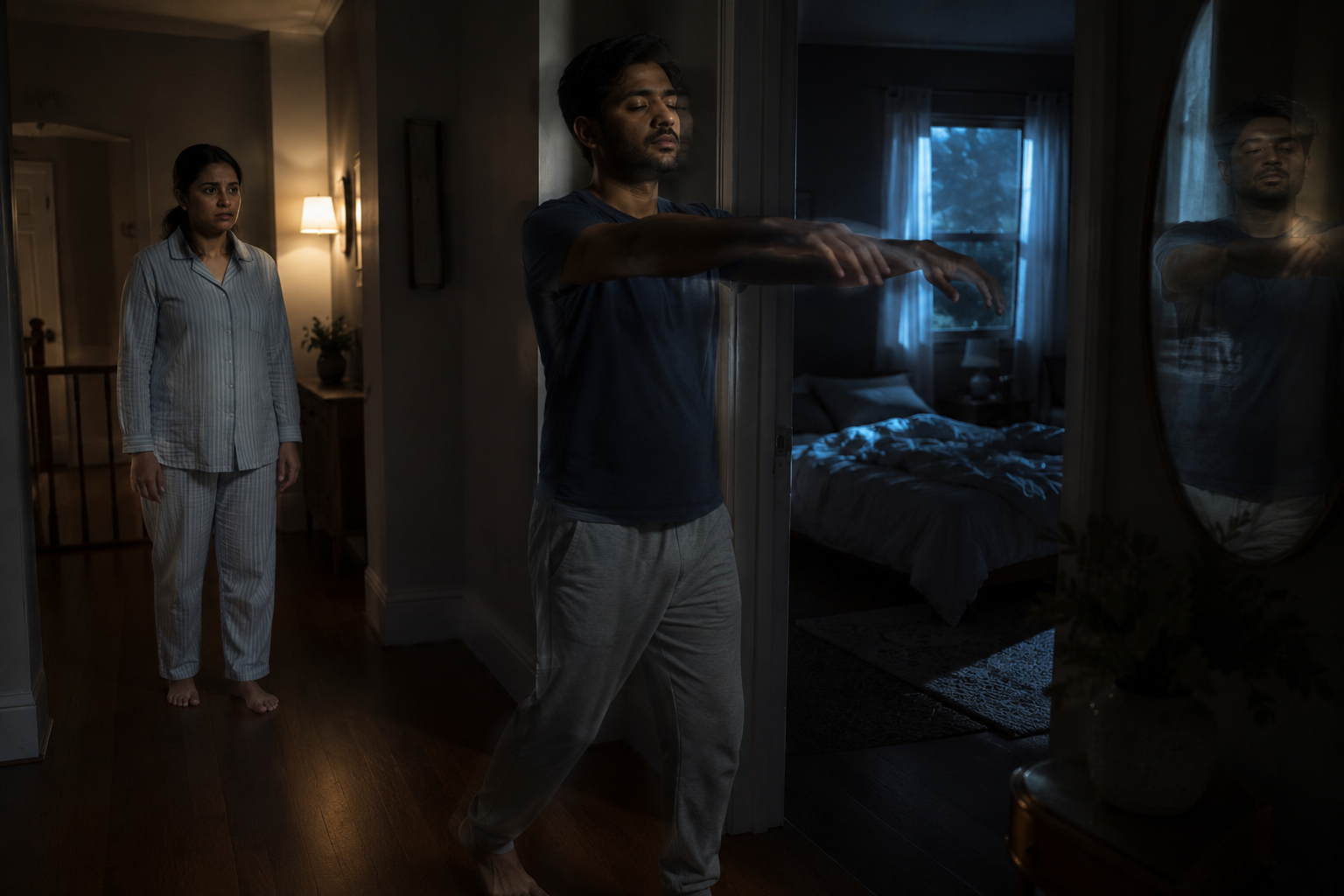
What to Pay Attention To
When unusual sleep behaviours show up, tracking a few key clinical details helps a doctor pinpoint the transition breakdown occurring within the brain:
1. Event Frequency
Evaluating how often the episodes occur—whether it's a rare one-off night or a recurring pattern.
2. Temporal Timing
Noticing which sleep stage they seem linked to—early night (NREM) or later, dream-heavy sleep (REM).
3. Safety Risk Profile
Checking whether there is any risk of physical injury to the person themselves or a bed partner.
4. Witness Observations
Gathering what family members or a bed partner have noticed that the person doesn't remember.
Not sure what your sleep behaviour means? Talk to Dr. Manish Aggarwal today.
Types of Parasomnia Disorders
Parasomnia isn't a single condition—it's a diverse group of distinct disorders, each presenting with its own physiological pattern, typical age group, and clinical symptoms.
Sleepwalking (Somnambulism)
Getting out of bed and walking or performing complex activities while still in deep NREM sleep. The person isn't consciously aware, has open yet vacant eyes, and usually carries no memory of it afterward. Often triggered by stress or sleep deprivation.
Night Terrors (Sleep Terrors)
Sudden episodes of intense vocalizations and physiological fear—screaming, a racing heart, profuse sweating—during deep NREM sleep. The individual remains largely unresponsive to physical comfort and holds zero memory of the event the next day.
REM Sleep Behavior Disorder (RBD)
A failure of the normal temporary muscle paralysis that occurs during REM sleep. Because the paralysis mechanism fails, individuals physically act out vivid dream content, sometimes forcefully enough to injure themselves or a bed partner.
Nightmare Disorder
Frequent, vivid, highly distressing dreams that repeatedly disrupt sleep architecture, cause severe waking distress, or create an intense fear of going to sleep. This stands apart from standard occasional nightmares.
Sleep Talking (Somniloquy)
Speaking aloud during sleep, ranging from simple unformed sounds to coherent full sentences. It is extremely common, occurs across all healthy profiles, and rarely requires independent clinical treatment.
Sleep Paralysis
A brief, terrifying inability to move or speak while falling asleep or waking up. Often accompanied by a false sense of presence or chest pressure, it usually resolves spontaneously within seconds or minutes.
Confusional Arousals
Waking up partially from deep sleep while appearing completely disoriented or confused. Features slow speech, blunted responses, and a high likelihood of returning to sleep with total amnesia of the arousal.
Sleep-Related Eating Disorder
Compulsive eating or drinking during sleep with partial or no conscious awareness. Often involves consuming unusual food combinations or risking self-injury while operating kitchen appliances in the dark.
Symptoms of Parasomnia
Symptoms vary significantly based on which stage transitions are failing, but the primary motor and cognitive signs include:
- •Sleepwalking or wandering around the house while asleep
- •Vocalizing or talking coherently during sleep
- •Physically acting out dreams (kicking, punching, hitting)
- •Abruptly screaming, crying out, or thrashing during deep sleep
- •Sudden violent or erratic movements while asleep
- •Pronounced confusion or disorientation immediately after waking
- •Recurrent intense night terrors, especially in children
- •Nocturnal eating or drinking with zero memory the next morning
Common Causes & Triggers
Parasomnia rarely has one standalone cause—it develops from a combination of physiological triggers that prevent the brain from seamlessly separating sleep stages:
Sleep Deprivation: Forces the body into prolonged deep NREM rebound sleep, heavily rising the chances of sleepwalking or night terrors.
Stress & Anxiety: Keeps the waking mind hyper-aroused, preventing smooth entry into quiet sleep stages and triggering nightmare disorders.
Obstructive Sleep Apnea (OSA): Repeated breathing pauses cause frequent brain awakenings. This severe fragmentation triggers confusional arousals and complex sleepwalking.
Alcohol & Medications: Disrupts normal sleep architecture, acts as a primary catalyst for RBD episodes, and alters chemical neuromodulators.
Genetics & Shift Work: Strong hereditary links dictate deep NREM vulnerabilities, while inconsistent circadian sleep shifts worsen timing errors.
Risk Factors Matrix
| Risk Factor | Why It Matters |
|---|---|
| Children | More inherently prone to sleepwalking and night terrors due to rapidly developing neurological sleep architecture. |
| Family History | Strong genetic links can predispose families to recurrent deep NREM partial arousal disorders. |
| Sleep Deprivation | Significantly intensifies slow-wave sleep rebound, increasing the baseline risk of confusional arousals. |
| Untreated Sleep Apnea | Frequent respiratory-driven micro-arousals heavily fragment the night, directly provoking motor episodes. |
| Stress & Anxiety Profiles | Substantially alters nighttime arousal thresholds, triggering vivid nightmares and restless behaviors. |
| Alcohol & Specific Sedatives | Impedes proper stage boundaries, causing significant structural changes in standard sleep patterns. |
| Older Adults | Show a significantly higher mathematical risk for REM Sleep Behavior Disorder, sometimes linked to neurodegenerative conditions. |
| Irregular Work Shifts | Constant rotation or erratic bedtimes heavily disrupt the natural circadian rhythm and stage pathways. |
Who Should Consider Evaluation?
An isolated sleep-talking episode during a high-stress week isn't a cause for panic. However, you should schedule a comprehensive evaluation with a sleep specialist if you check any of these warning signs:
Concern or distress from a bed partner regarding what they are witnessing is an entirely valid, common reason to seek a clinical workup.
How Parasomnia Is Diagnosed
Diagnosing a parasomnia disorder requires mapping the absolute synchronization between brainwave shifts and physical muscle movements. Because patients are completely unconscious during events, the diagnostic pathway relies heavily on dual streams of data:
Meticulous History
Mapping complete medical, psychiatric, medication, and family history paired with precise sleep tracking diaries over 1–2 weeks.
Third-Party Observations
Collating descriptive logs from family members or bed partners, which provide vital context regarding layout, timing, and behavior.
Video Polysomnography
The clinical gold standard. An overnight laboratory sleep study recording continuous EEG, muscle tone, breathing metrics, and synchronized high-definition video.
Parasomnia Treatment Strategy
Treatment focuses on reducing episode frequency, eliminating motor risks, and correcting any underlying respiratory arousals rather than just suppression:
Rigid Sleep Hygiene & Environmental Protection
Establishing predictable bedtime boundaries while creating strict bedroom safety protocols—securing windows/doors, clearing floor hazards, or padding the sleep area to prevent injuries.
Imagery Rehearsal Therapy (IRT)
An evidence-based cognitive therapy explicitly utilized for nightmare disorder, training the waking mind to reshape and overwrite recurring distressing themes.
Targeted Relaxation & Stress Therapy
Deploying guided bio-relaxation techniques and cognitive-behavioral tools to dramatically decrease bedtime sympathetic nervous system spikes.
Resolution of Underlying Airway Arousals
Integrating CPAP therapy or specialized ventilation if diagnostic data proves that obstructive sleep apnea is the primary trigger causing stage fragmentation.
Medications are never a generic first-line fix; they are introduced selectively for severe motor profiles like adult RBD and are carefully supervised over long-term tracking.
What to Expect During Your Consultation
Your initial clinical meeting involves a deep-dive analysis of episode morphology, onset patterns, and lifestyle triggers. Dr. Manish Aggarwal looks at the complete systemic framework—incorporating bed-partner observations and checking for hidden airway fragmentation—to build a personalized treatment plan geared specifically toward your unique parasomnia variant.
Frequent, dangerous, or highly disruptive parasomnia symptoms do not have to just be accepted.
Why Choose Dr. Manish Aggarwal for Parasomnia Care?
Dual specialization as a Pulmonologist and Sleep Specialist, perfectly isolating airway triggers from neural events.
Deep diagnostic access to high-definition video polysomnography labs for precise event capturing.
Strictly evidence-based protocols that aggressively prioritize behavioral modifications over premature sedation.
Comprehensive long-term tracking maps aimed at full lifestyle coordination and tracking neurological health indicators.
Frequently Asked Questions
Parasomnia is a sleep disorder that causes unusual behaviours, movements, or emotions during sleep—such as sleepwalking, talking, or acting out dreams—because the brain is partly asleep and partly awake at the same time.
It occurs when the brain doesn't transition smoothly between sleep stages, often influenced by factors like sleep deprivation, stress, or an underlying sleep disorder such as sleep apnea.
Common causes include sleep deprivation, stress, anxiety, alcohol use, certain medications, sleep apnea, neurological conditions, genetics, and irregular sleep schedules.
Most are not, particularly in children, where many types resolve naturally with age. However, some—especially those involving physical movement like sleepwalking or REM Sleep Behavior Disorder—carry a risk of injury and are worth evaluating if episodes are frequent.
Yes, these are fairly common in childhood and often resolve on their own with age. Evaluation is generally only needed if episodes are frequent, dangerous, or continue into adolescence and beyond.
Yes. Stress and anxiety are common triggers for several types, including nightmare disorder and confusional arousals, and can also worsen the frequency of sleepwalking episodes.
It's generally recommended for evaluation, both due to the risk of injury during episodes and its recognised association with certain neurological conditions, which makes proper diagnosis and follow-up particularly important.
Not always, but a video polysomnography is often recommended when the type is unclear, episodes are frequent or risky, or an underlying condition like sleep apnea is suspected.
Treatment includes sleep hygiene guidance, safety measures, therapies such as Imagery Rehearsal Therapy and relaxation training, and treating any underlying sleep disorder. CPAP therapy may help if sleep apnea is involved, and medication is used only when clinically appropriate.
Many improve significantly, or resolve entirely, with the right combination of lifestyle changes, safety measures, and treatment of any underlying cause. Outcomes vary by type and individual factors, which is why a personalised evaluation matters.
No. Narcolepsy belongs to a different category called Central Disorders of Hypersomnolence, which mainly involves excessive daytime sleepiness rather than abnormal behaviours during sleep.
Still have questions?
We are available to answer queries, schedule urgent EBUS sessions or arrange Sleep diagnostic devices.
Don't Just Manage Disruptive Sleep Behaviours
Protect your home environment and physically secure your nights. Move toward a structured, root-cause treatment plan with expert clinical guidance in Delhi.